
Free tool
CBM calculator for cartons and crates
Enter carton dimensions and quantity to see shipment volume in cubic metres. Add each product in its own row — furniture, tiles or building materials — and switch the whole sheet between centimetres and inches.
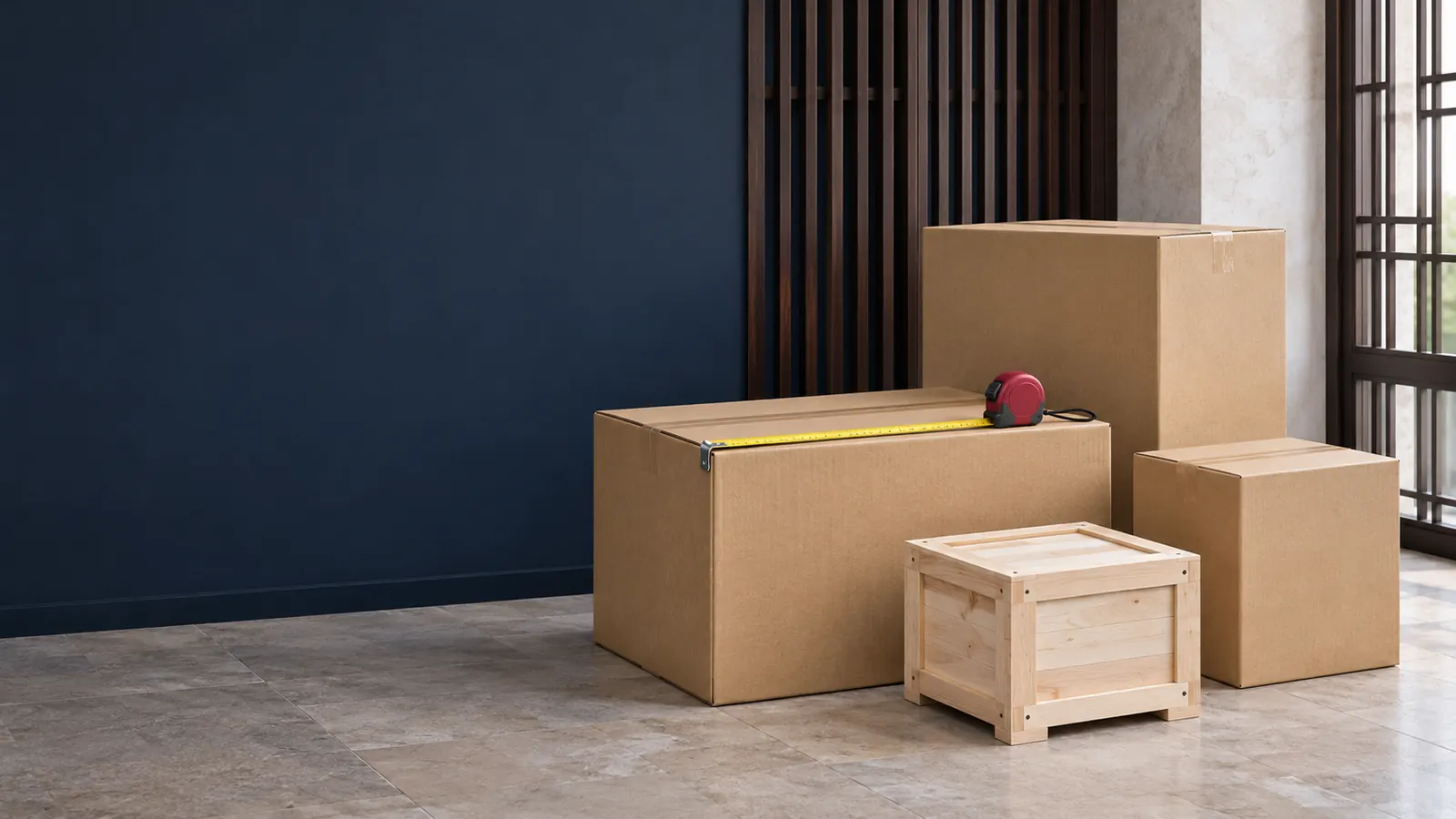
Illustrative image — not a photo of our premises or a client's.
Work out your shipment volume
One row is one carton size. Enter the outside dimensions of the packed carton and the number of cartons, then add another row for the next product. Every field starts blank, so the total reflects only what you measured.
Shipment volume
Enter the outside dimensions of one packed carton and the number of cartons. Add a row for each carton size; the total is the shipment volume in cubic metres, before pallets or crates.
Switching units converts the length, width and height already entered. Carton counts stay as they are.
Up to 20 carton sizes in one sheet.
A row is counted when its dimensions are positive numbers and its carton count is a positive whole number. Rows with missing or invalid values are left out, and the result shows how many were omitted.
How the calculator works out the volume
The arithmetic is the same one a forwarder uses to measure a shipment, with no hidden divisor and no rounding between rows.
| Question | How the calculator answers it |
|---|---|
| Volume of one carton in centimetres | Length × width × height, divided by 1,000,000. |
| Volume of one carton in inches | Length × width × height, multiplied by 0.000016387064. |
| Volume for one carton size | Volume of one carton multiplied by the number of cartons. |
| Total shipment volume | Every complete row added together. |
| A row with a blank field | Left out of the total until all four values are entered. |
An example: a carton measuring 60 × 40 × 35 cm is 0.084 m³. Ten of those cartons are 0.84 m³. One inch is 2.54 cm exactly, which is why the inch formula uses a long decimal rather than a rounded number.
What to measure
- The outside of the packed carton
- Measure the carton as it will travel, including any bulge from the contents. An empty or flat-packed carton measures smaller than the one that ships.
- Cartons, not pieces
- If one carton holds several chairs or tiles, enter the carton count. The calculator needs the number of boxes, not the number of items inside them.
- One row per carton size
- A sofa packed in two carton sizes gets two rows. Each size is measured once and multiplied by its own count.
- Pallets and crates as a unit
- If a forwarder collects a finished pallet or wooden crate, measure the outside of that unit and enter it as its own row. Do not add the pallet to a carton total as well.
- The packed size, not the product size
- Supplier sheets sometimes list the product dimensions rather than the carton. If a figure looks too small for the box, ask the supplier for the packed carton size.
- One unit across the sheet
- Switch the whole sheet between centimetres and inches. Mixing the two in one total gives a number that cannot be right.
What volume does not tell you
Volume, not a freight quote
The calculator measures space. It does not price freight, choose a container or know your goods. Confirm the shipping charge with a forwarder who has the carton count, the weight and the destination.
- Chargeable weight. Forwarders compare the actual weight with the volume and charge the greater figure under their own rule. CBM is only the space half of that comparison.
- Container fit. A container has a usable volume below its nominal size once cartons, pallets and loading gaps are counted, so a total close to the box's published capacity may still not fit.
- Stacking and height. A pallet that cannot be stacked may take more container height than its own volume suggests.
- Shape. The calculator treats every carton as a rectangle. A round or tapered item still occupies the box it ships in, so measure that box.
- Weight limits. Dense goods such as tiles can reach a container's weight limit while space remains.
From volume to a shipping inquiry
- 1
Keep the total with the packing list
Copy the summary and compare it with the supplier's carton count. A difference is easier to fix before the goods leave the factory.
- 2
Add the destination
A volume without a port is not enough to quote. Note the destination port or city and the address the goods must reach.
- 3
Ask for the chargeable weight
Send the volume and carton count, and ask the forwarder for the chargeable weight and the service it applies to.
- 4
Choose the shipping method
Small volumes often move as LCL; a load that fills a container is usually quoted as FCL. The shipping guide explains the trade-off without inventing rates.
Questions about CBM and carton volume
What is CBM in shipping?
How do I calculate CBM from carton dimensions?
Should I include the pallet or crate in the volume?
Does CBM tell me what shipping will cost?
Do I enter pieces or cartons?
Have the volume — need the shipping side?
Send the carton sizes, the total volume and the destination port. We reply with the questions a forwarder needs and help with collection on the China side.